
Infographic -Foreign workers in Japan-


Recently, in Japan, I often see foreigners working at convenience stores. I feel that the number of other industries such as restaurants, hotels, and agriculture are also increasing. How is it actually going? I looked it up the relevant data.

It seems that there is a serious human resources shortage behind Japan’s acceptance of foreign workers. Japan faces the total population decreasing and it is expected to fall below 100 million in 2050. In December 2018, Japanese government revised the law and established new two statuses of residence in 14 industries such as construction, ship building, nursing care, agriculture and so on. This updated institution will be implemented in this April 2019.

The problems must be tackled promptly are disappearance of technical interns, illegal overtime and unpaid wages. Japanese government also plans to set up an immigration bureau newly in this April 2019 to improve these acceptance environment.
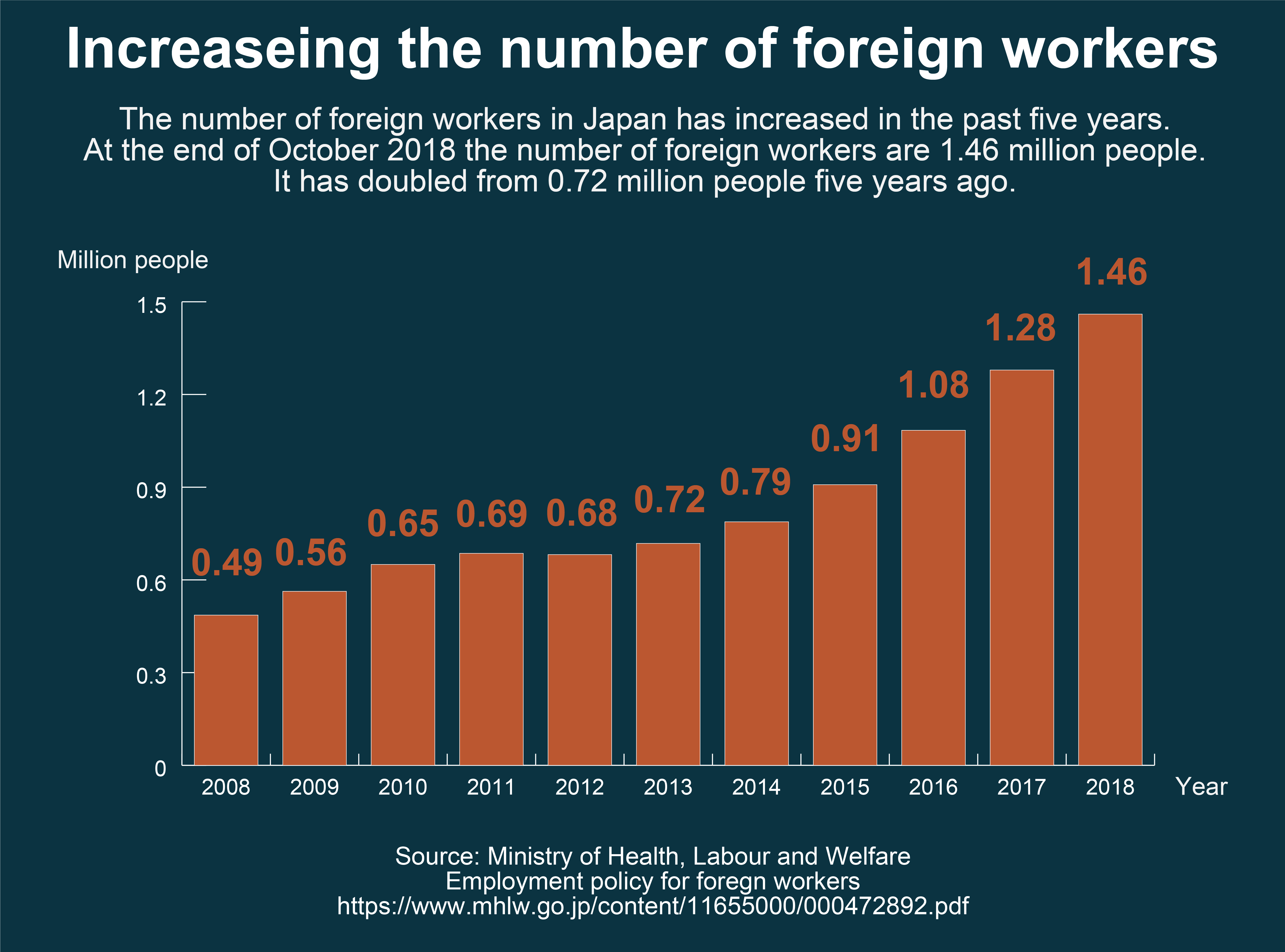

Increasing the number of foreign workers in Japan
The number of foreign workers in Japan has increased in the past five years. At the end of October 2018 the number of foreign workers are 1.46 million people. It has doubled from 0.72 million people five years ago.
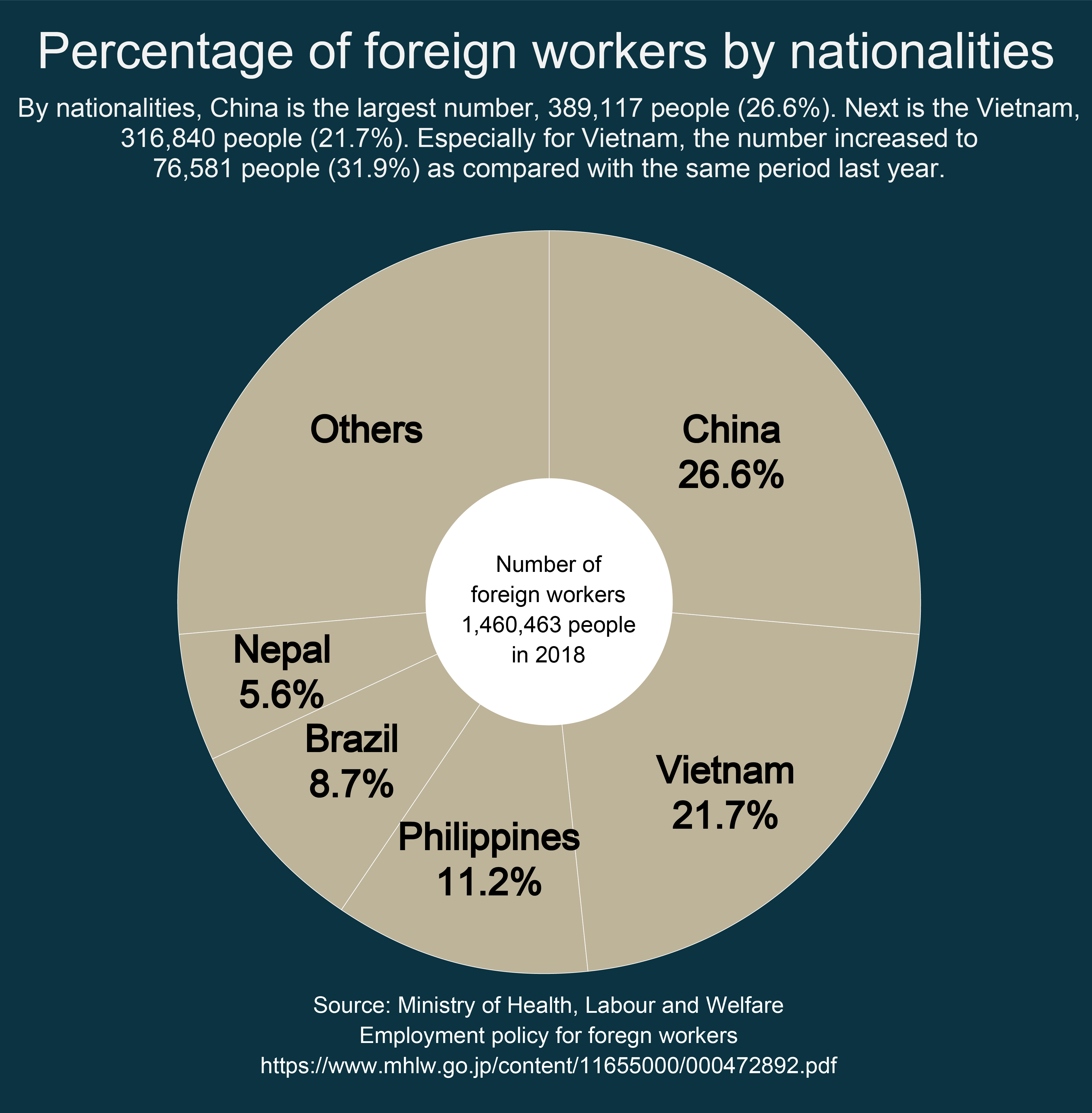

Percentage of foreign workers in Japan by nationalities
By nationalities, China is the largest number, 389,117 people (26.6%). Next is the Vietnam, 316,840 people (21.7%). Especially for Vietnam, the number increased to 76,581 people (31.9%) as compared with the same period last year.
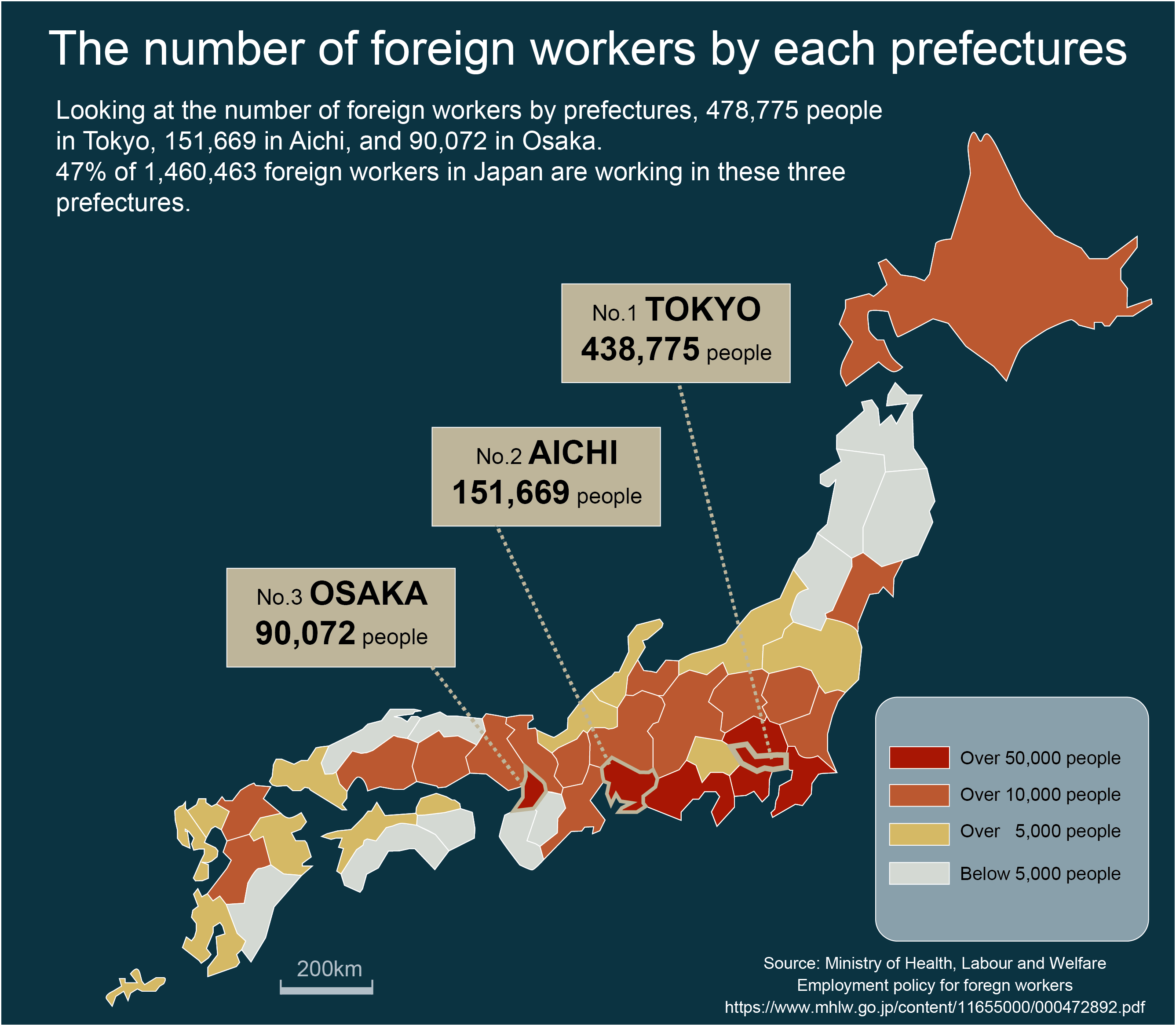

The number of foreign workers in Japan by each prefectures
Looking at the number of foreign workers by prefectures, 478,775 people in Tokyo, 151,669 in Aichi, and 90,072 in Osaka. 47% of 1,460,463 foreign workers in Japan are working in these 3 prefectures.
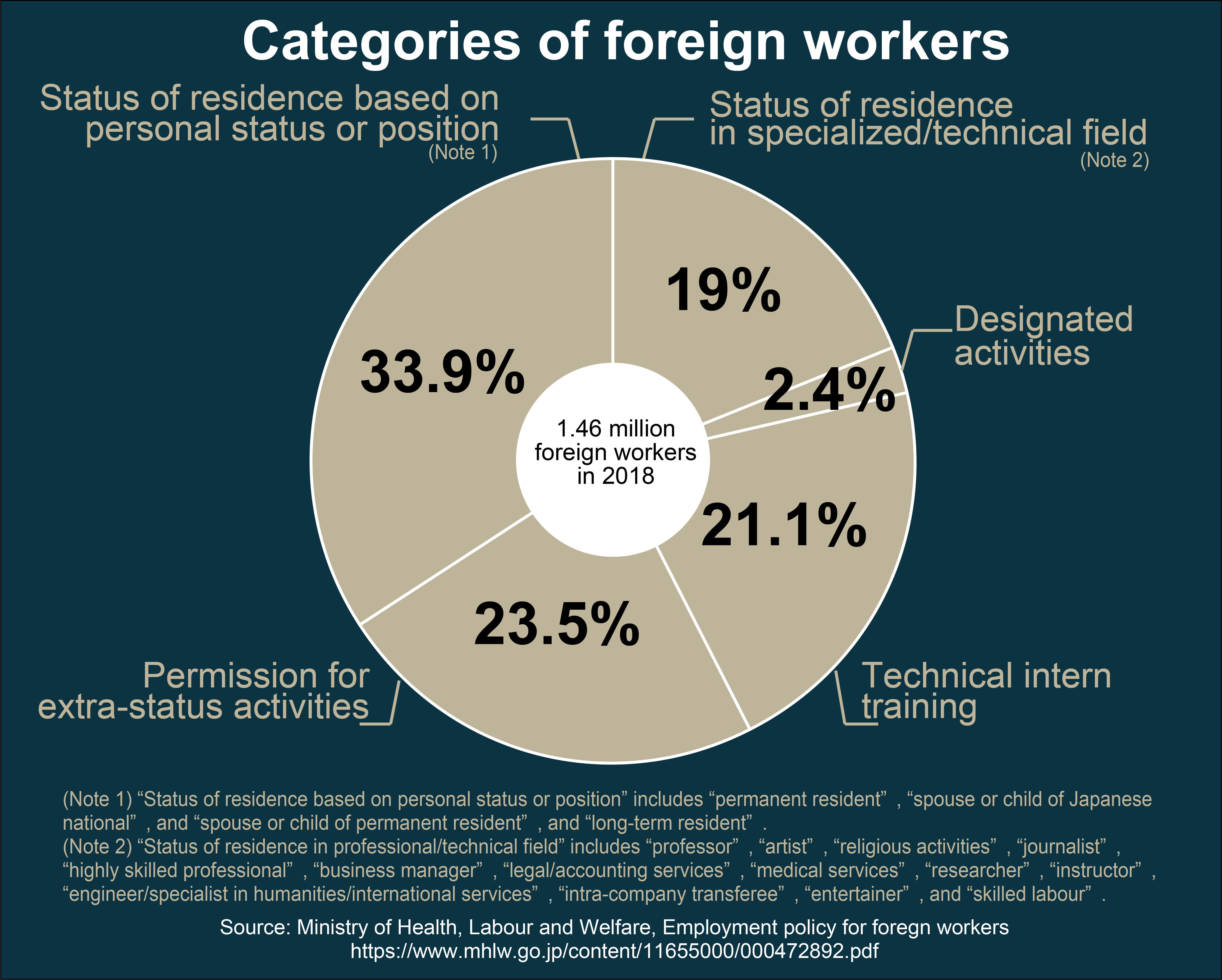

Categories of foreign workers
Firstly, “Status of residence based on personal status or position” such as permanent resident and Japanese wife is the most common. Secondly, there are a lot of foreign students who come to Japan with “Permission for extra-status activities”. Working is not the main purpose, but in many cases they work as part time jobs in convenience stores and restaurants.
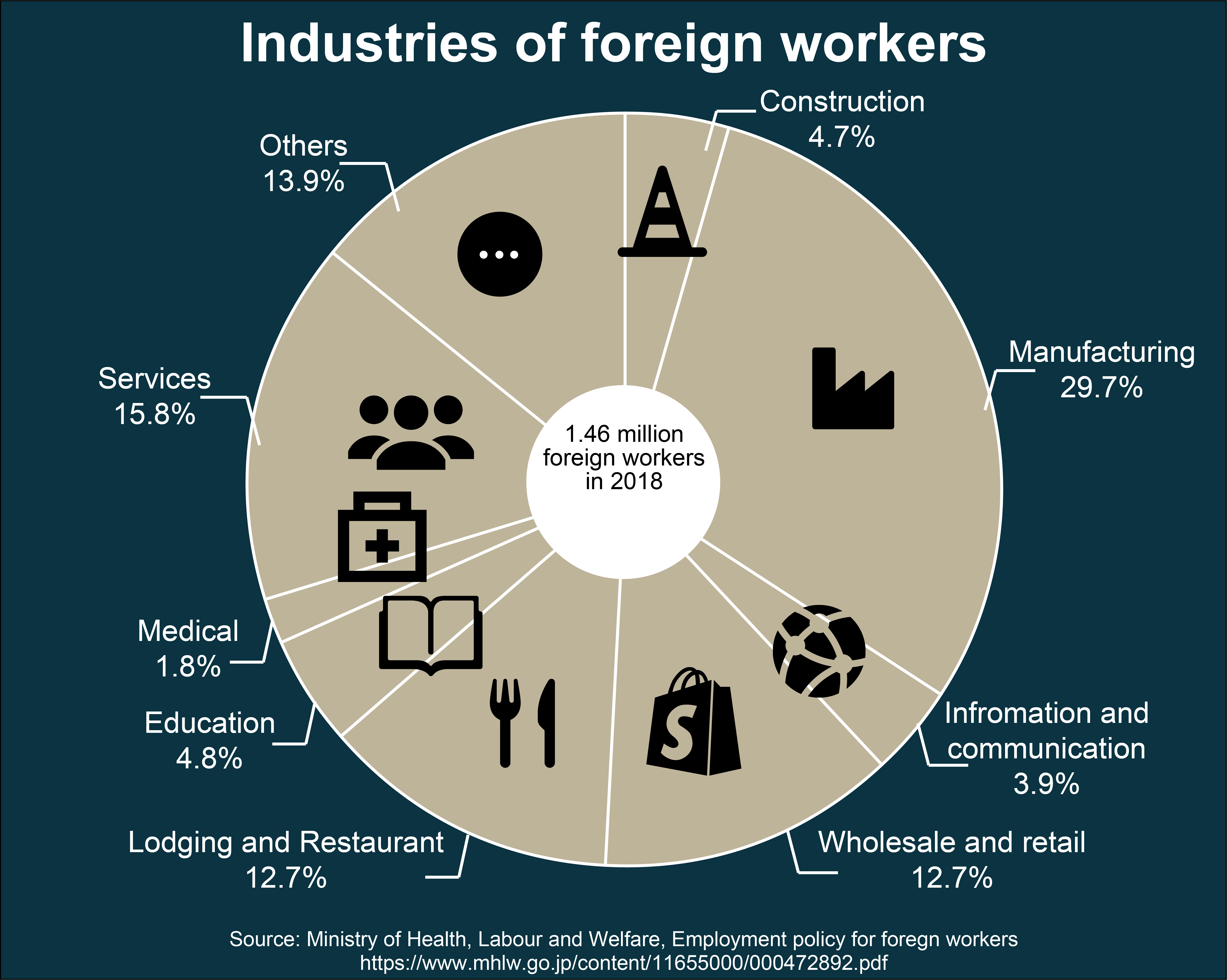

Industries of foreign workers
By the employment industry of foreign workers, manufacturing (29.7%), services (15.8%), wholesale and retail (12.7%) and lodging and restaurant (12.7%) are high ratio.
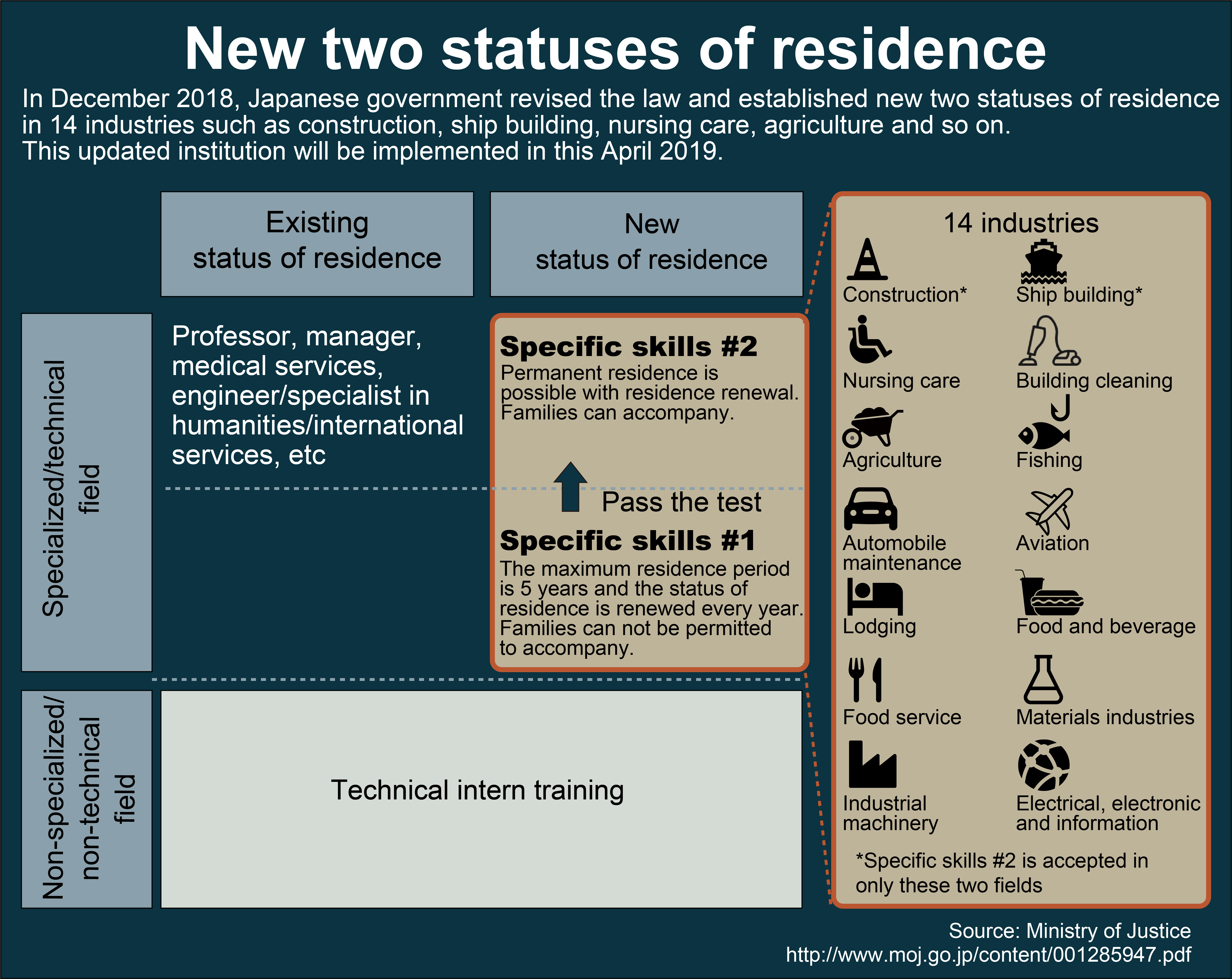

New two statuses of residence
On December 8, 2018, Japanese government revised the law and established new two statuses of residence in 14 industries such as construction, ship building, nursing care, agriculture and so on. This updated institution will be implemented in this April 2019.
A Digital Christmas Card 2018


Merry Christmas to the best friend in the world. I’m wishing you joy and blessings this Christmas. This is a digital Christmas card from me. Many thanks.

Recently I finished one of edX courses, Scratch: Programming for Teachers. I wrote before why I started learning programming and what programming language I am interested in.

After this lecture, I would like to plan two types of courses. One is the course to deal with programming in Scratch with an inspiring and clear way for the children who learn programming first time. And second one is to make the digital greeting card using Scratch for adults.

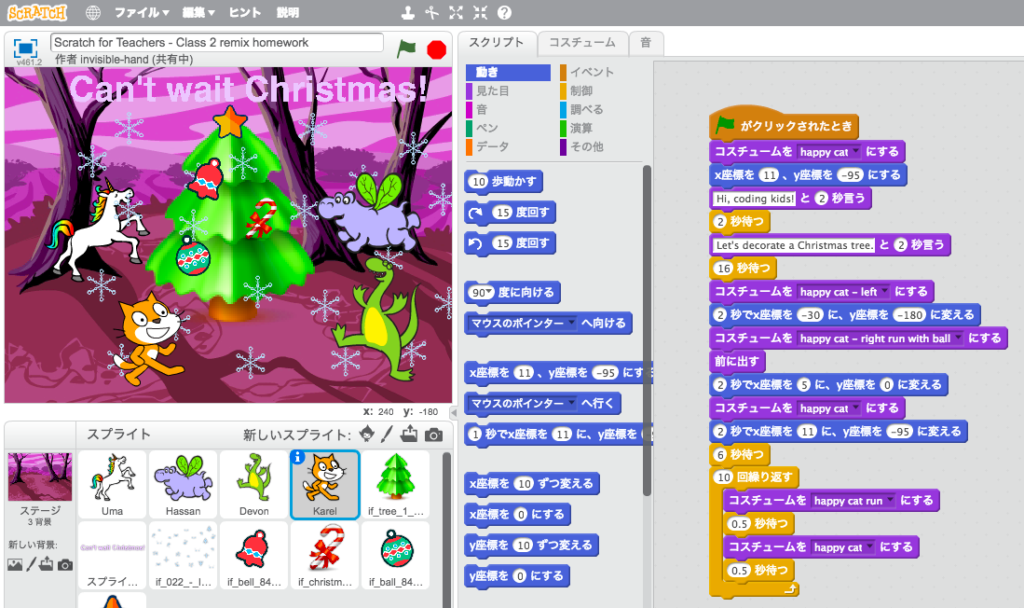
Therefore, I create one of the examples as a digital Christmas card. Scratch has various possibilities not only greeting cards but also quizzes, games and stories. I would like to continue exploring these possibilities and offering of courses.

Alvar Aalto – Second Nature

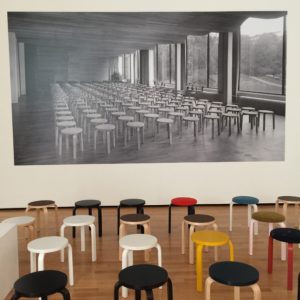
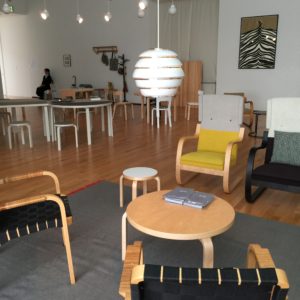
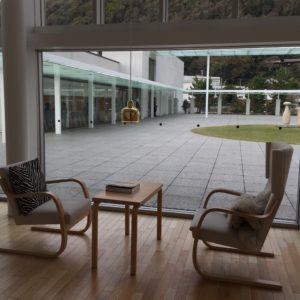
I visited The Museum of Modern Art, Hayama to see Alvar Aalto Exhibitions on Friday. Alvar Aalto (1898-1976) was a leading Finnish architect of the twentieth century. This exhibition is planned by Vitra Design Museum and Alvar Aalto Museum and touring the world.

We are able to see both detailed drafts and artful works. He utilized natural materials and light for his architectures. Functional, standardized and flexible works such as apartment house and mass-oriented products were introduced as well. A film about transition of Finnish history and industry were screened in one corner.

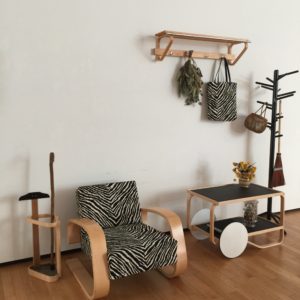
In this exhibition, I had two discoveries. The first one was a method of softly bending solid wood trees. Stool 60 was made by innovative way to bent L shaped leg and patented in 1933. Here is the video.

The second one was his initiative itself. When I saw the manifest of Artek, my heart was extremely moved. Artek was a company founded in Helsinki in 1935 by four young idealists: Alvar and Aino Aalto, Maire Gullichsen, and Nils-Gustav Hahl. The name Artek is a synthesis of “art” and ‘technology’ – concepts central to the international modernist movement that came to prominence in the 1920s. Their goal of Artek was “to sell furniture and to promote a modern culture of living by exhibitions and other educational means”(Artek web site) . Here is the manifest, scroll down the web page and we can select manifest. This was a conceptual diagram of the company that art, design, and propaganda were closely connected, aiming for global activities while collaborating with some organizations. I could not believe that was conceived in 1935.

Hayama is a peaceful place I can return myself. This day I had a day-off and thought about myself in front of the sea. “Life is like a box of chocolates. You never know what you’re gonna get until you open it up.” This is the quote from 1994 film Forrest Gump. I am excited about the future I do not know what will happen. It was mild cloudy and sometimes the sun was peeping at her face.

Photography: invisible-hand

References

Why Programming?

In today’s digital world, coding becomes an important skill. I have joined MIT’s online community Learning Creative Learning (LCL) since this October, and I was interested in Scratch that is one of the programming languages. As I wanted to learn Scratch deeply, I began to take the edX online course, Scratch: Programming for Teachers. The objectives of this course are learning how to deal with programming in Scratch, broadening programming concepts, and discussing strategies/approaches for teaching. I am not a teacher but a parent and a person interested in STEAM. It is suitable for me because I want to learn Scratch itself and acquire the skills to deliver this attractive tool to children and adults.

What is programming?
At first, the lecturer of this course mentioned when we talk about programming education, one of the biggest questions is what is programming. It is a deep question but a basic answer is programming is getting a computer to do something. As digitalization advances, programming becomes more important.

Why do all children need to know programming?
This lecture taught me three reasons why programming is so important. The first reason is job markets are expanding in a few years and we might need more programmers because of the software importance. The second reason is to understand the world trends. There are lots of software related News. The third reason is programming is creative. We can self-express by programming. Childhood is a great time to start programming and develop computational thinking, creativity and problem solving.

What programming language should I use?
There are lot of languages like HTML, CSS, javascript, PHP, Python and so on. One of the benefits of Scratch is we can set our own language because research has shown that children learn better in their own language. Another benefit is we need not install anything. We just connect internet and sign in Scratch page. The third benefit is Scratch includes blocks right there. We need not memorize and search the code itself. It looks too easy and childish as we can just move the cat but it is a real and powerful programming language.

I have some opportunities to learn Scratch recently and I enjoy, explore, tinker, and reflect with peers. I would like to combine with other hardware and and apply it.


My recent Scratch project: Cant’t wait Christmas (DelftX: ScratchTENGX Week2 Homework) Coding kids decorate a Christmas tree. Using programming concept: Timing, different look.

References

  • DelftX: ScratchTENGX. Scratch: Programming for Teachers. Week1. Week2.
  • Hill, B. (2017). Learning to Code in One’s Own Language. Retrieved from https://mako.cc/copyrighteous/scratch-localization-and-learning