A Digital Christmas Card 2018


Merry Christmas to the best friend in the world. I’m wishing you joy and blessings this Christmas. This is a digital Christmas card from me. Many thanks.

Recently I finished one of edX courses, Scratch: Programming for Teachers. I wrote before why I started learning programming and what programming language I am interested in.

After this lecture, I would like to plan two types of courses. One is the course to deal with programming in Scratch with an inspiring and clear way for the children who learn programming first time. And second one is to make the digital greeting card using Scratch for adults.

Therefore, I create one of the examples as a digital Christmas card. Scratch has various possibilities not only greeting cards but also quizzes, games and stories. I would like to continue exploring these possibilities and offering of courses.

Alvar Aalto – Second Nature

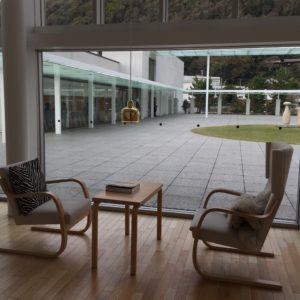
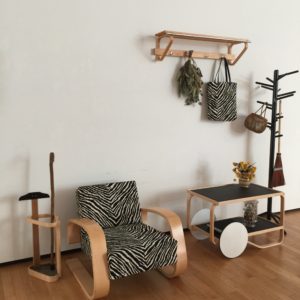
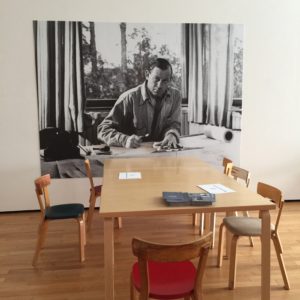
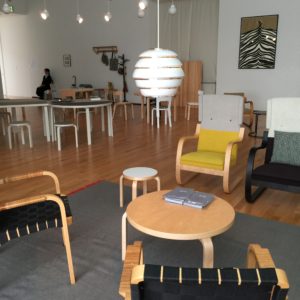
I visited The Museum of Modern Art, Hayama to see Alvar Aalto Exhibitions on Friday. Alvar Aalto (1898-1976) was a leading Finnish architect of the twentieth century. This exhibition is planned by Vitra Design Museum and Alvar Aalto Museum and touring the world.

We are able to see both detailed drafts and artful works. He utilized natural materials and light for his architectures. Functional, standardized and flexible works such as apartment house and mass-oriented products were introduced as well. A film about transition of Finnish history and industry were screened in one corner.

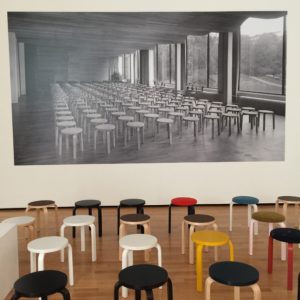
In this exhibition, I had two discoveries. The first one was a method of softly bending solid wood trees. Stool 60 was made by innovative way to bent L shaped leg and patented in 1933. Here is the video.

The second one was his initiative itself. When I saw the manifest of Artek, my heart was extremely moved. Artek was a company founded in Helsinki in 1935 by four young idealists: Alvar and Aino Aalto, Maire Gullichsen, and Nils-Gustav Hahl. The name Artek is a synthesis of “art” and ‘technology’ – concepts central to the international modernist movement that came to prominence in the 1920s. Their goal of Artek was “to sell furniture and to promote a modern culture of living by exhibitions and other educational means”(Artek web site) . Here is the manifest, scroll down the web page and we can select manifest. This was a conceptual diagram of the company that art, design, and propaganda were closely connected, aiming for global activities while collaborating with some organizations. I could not believe that was conceived in 1935.

Hayama is a peaceful place I can return myself. This day I had a day-off and thought about myself in front of the sea. “Life is like a box of chocolates. You never know what you’re gonna get until you open it up.” This is the quote from 1994 film Forrest Gump. I am excited about the future I do not know what will happen. It was mild cloudy and sometimes the sun was peeping at her face.

Photography: invisible-hand

References

Why Programming?

In today’s digital world, coding becomes an important skill. I have joined MIT’s online community Learning Creative Learning (LCL) since this October, and I was interested in Scratch that is one of the programming languages. As I wanted to learn Scratch deeply, I began to take the edX online course, Scratch: Programming for Teachers. The objectives of this course are learning how to deal with programming in Scratch, broadening programming concepts, and discussing strategies/approaches for teaching. I am not a teacher but a parent and a person interested in STEAM. It is suitable for me because I want to learn Scratch itself and acquire the skills to deliver this attractive tool to children and adults.

What is programming?
At first, the lecturer of this course mentioned when we talk about programming education, one of the biggest questions is what is programming. It is a deep question but a basic answer is programming is getting a computer to do something. As digitalization advances, programming becomes more important.

Why do all children need to know programming?
This lecture taught me three reasons why programming is so important. The first reason is job markets are expanding in a few years and we might need more programmers because of the software importance. The second reason is to understand the world trends. There are lots of software related News. The third reason is programming is creative. We can self-express by programming. Childhood is a great time to start programming and develop computational thinking, creativity and problem solving.

What programming language should I use?
There are lot of languages like HTML, CSS, javascript, PHP, Python and so on. One of the benefits of Scratch is we can set our own language because research has shown that children learn better in their own language. Another benefit is we need not install anything. We just connect internet and sign in Scratch page. The third benefit is Scratch includes blocks right there. We need not memorize and search the code itself. It looks too easy and childish as we can just move the cat but it is a real and powerful programming language.

I have some opportunities to learn Scratch recently and I enjoy, explore, tinker, and reflect with peers. I would like to combine with other hardware and and apply it.


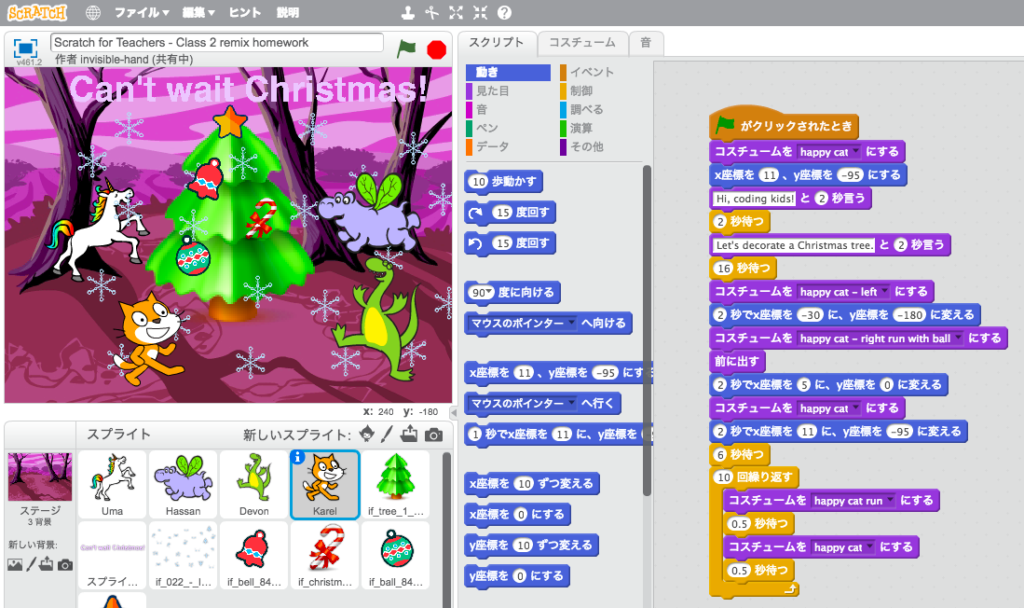
My recent Scratch project: Cant’t wait Christmas (DelftX: ScratchTENGX Week2 Homework) Coding kids decorate a Christmas tree. Using programming concept: Timing, different look.

References

  • DelftX: ScratchTENGX. Scratch: Programming for Teachers. Week1. Week2.
  • Hill, B. (2017). Learning to Code in One’s Own Language. Retrieved from https://mako.cc/copyrighteous/scratch-localization-and-learning

Learning Creative Learning

Five weeks have passed since I joined Learning Creative Learning or LCL which is online community organized by the Lifelong Kindergarten group at the MIT Media Lab. Today, I think what is so special about the kindergarten approach to learning? Why do I think it is a good model for learners of all ages?

Remember your kindergarten activity
At the time of kindergarten, I imagined fantastic stories, played with sands, made mountains, dug tunnels and collaborated with friends. When the mountain collapsed, the teacher or parent came over and encouraged us. They showed or advised the importance of foundation and the children could notice to solidify the foundation using water. Based on these experiences going through the spiral, the children could imagined the new ideas and new directions. LCL defines these processes as the Creative Learning Spiral.

The Creative Learning Spiral
The Creative Learning Spiral is the creative process as kindergarten children play with blocks, build castles, and tell stories (Resnick, 2017). It is the engine of creative thinking. After kindergarten, most people shift away from the Creative Learning Spiral. Students spend much time for sitting at desk, filling out worksheet, and just listening to lectures. I may have forgotten this spiral since childhood. However I revived this spiral again after joining LCL community. Interestingly, my 8 years old daughter is faster to create something than me. She made some creatures with blocks/crews, sewed the clothes for dolls, and made scratch projects during I was thinking. It was one of discoveries through LCL.
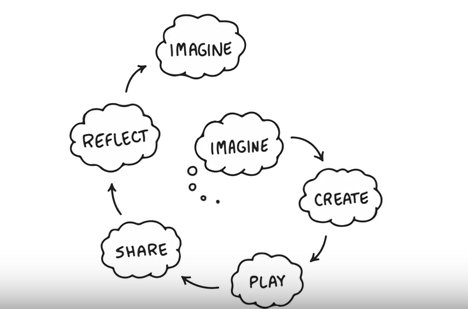

The Creative Learning Spiral
(Resnick, 2017. Lifelong Kindergarten. p11.)

Creative learning framework: Four P’s
In the LCL community, we learned the creative learning spiral and big ideas of creative learning including four P’s. Four P’s, a framework for creative learning, means Projects, Passion, Peers and Play. We focused on the one P’s in a week, learned the concept by watching videos and reading articles/books, moved hands and made things, shared the ideas and discussed in the community.

Learning Creative four P’s

  • Projects: We focus on learning through making, and reflect on the creative process through Creative Learning Spiral.
  • Passion: We explore motivation in learning, along with strategies to engage people in meaningful experiences.
  • Peers: We focus on learning social activity. We explore remixing and support people connecting to each other to share ideas, collaborate on projects, and build on one another’s work.
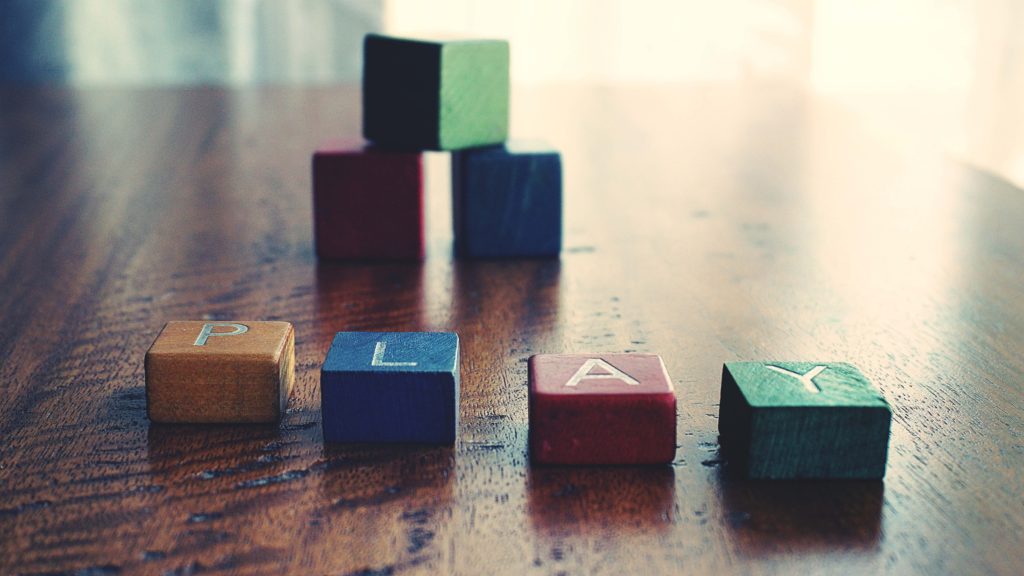
  • Play: We playfully explore Play. We discuss different types of paly, provide opportunities for tinkering, and share strategies to promote a playful approach to learning.
  • (LCL Website)

Through weekly activities, I made two Scratch projects and my daughter also made her projects. Scratch is guided by these four P’s of creative learning.

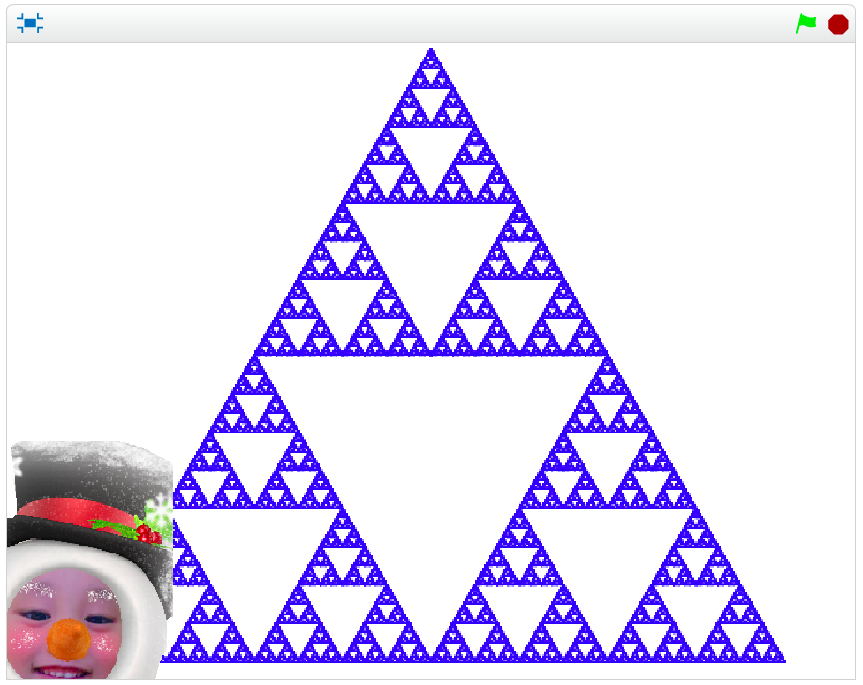
Sierpingski gasket
A rotating snow-girl draws Sierpinski gasket.Please enjoy with a Christmas song.
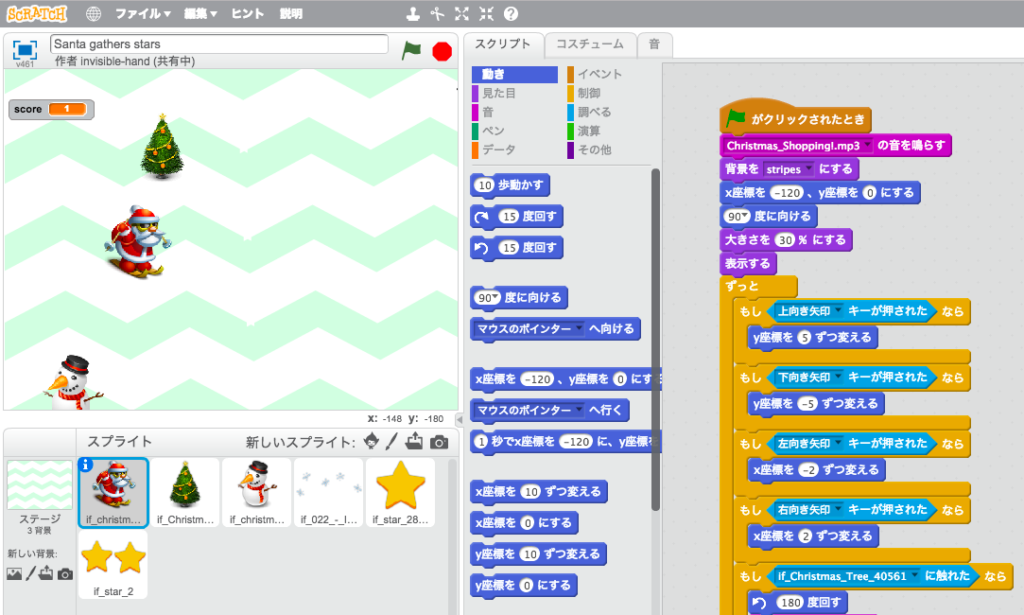
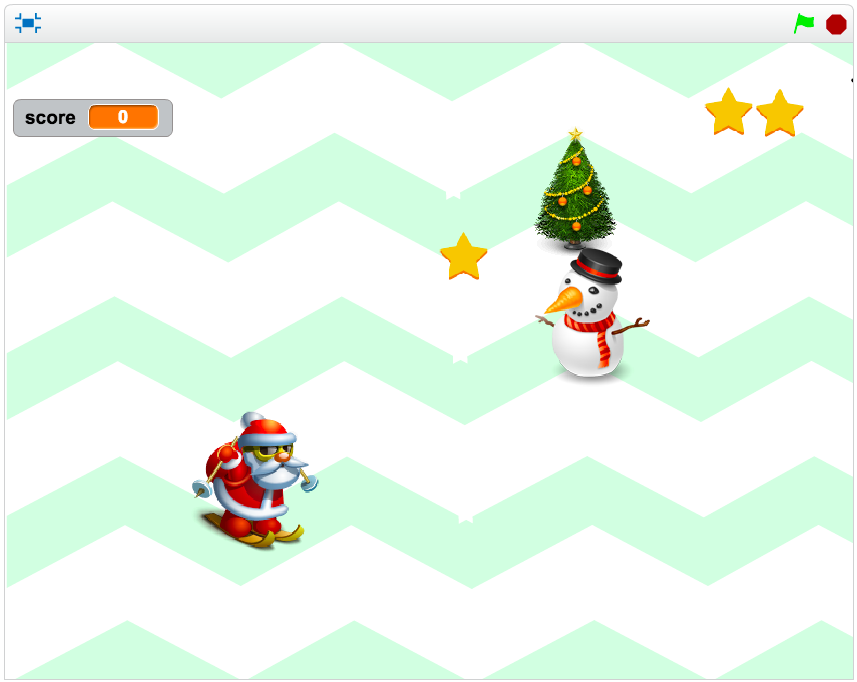
Santa gathers stars
This is the game. You are a Santa. Let’s save stars avoiding Christmas trees and snowmen. If Santa touch a Christmas tree and a snowman, the game is over.
I wrote about my childhood toys before. I introduced my favorite plastic models. Now I found playing with plastic models or any other existing toys were like playing in a playpen. There are only fixed and limited manuals/rules. These processes are much more efficient, however less creativity and agility. According to Resnick (2017), Danish has two different words for play. The word spille is used to describe the types of play that have a defined structure and sets of rules, like playing sports or playing a video game, whereas the word lege is used to describe play that is imaginative and open-ended, without an explicit goal. It seems appropriate that the Danish toy company is named LEGO, a contraction of lege with godt, meaning play well. In our surroundings, I feel there are so many things as a playpen. These are also existed in trendy programming and robot making curricula because these only provide the way people traces the codes that were taught. Do we image fantasy? Do we create, play, share and reflect? If we do not and just proceed with manuals/rules, it can not cultivate creative learning. I would like to enjoy the way what I did in the kindergarten. I think the kindergarten approach is a good model for all ages learners.

References

  • Resnick, M. (2017). Lifelong Kindergarten. Cultivating Creativity through Projects, Passion, Peers, and Play. The MIT Press.
  • LCL Website. Retrieved from https://learn.media.mit.edu/lcl/
Gears of my childhood

A new round of Learning Creative Learning or LCL started on Wednesday, October 9th and I joined. It is an online community organized by the Lifelong Kindergarten group at the MIT Media Lab, led by Mitch Resnick. It aims to connect and share ideas with people around the world with similar goals, visions, and values. There is an opportunity for like-minded educators and learners to meet one another and share ideas, strategies, and practical tips on how to support creative learning (LCL Website).

First week, we discuss the Lifelong Kindergarten approach and share a childhood object. I thought about some objects from my childhood that interested and influenced me.

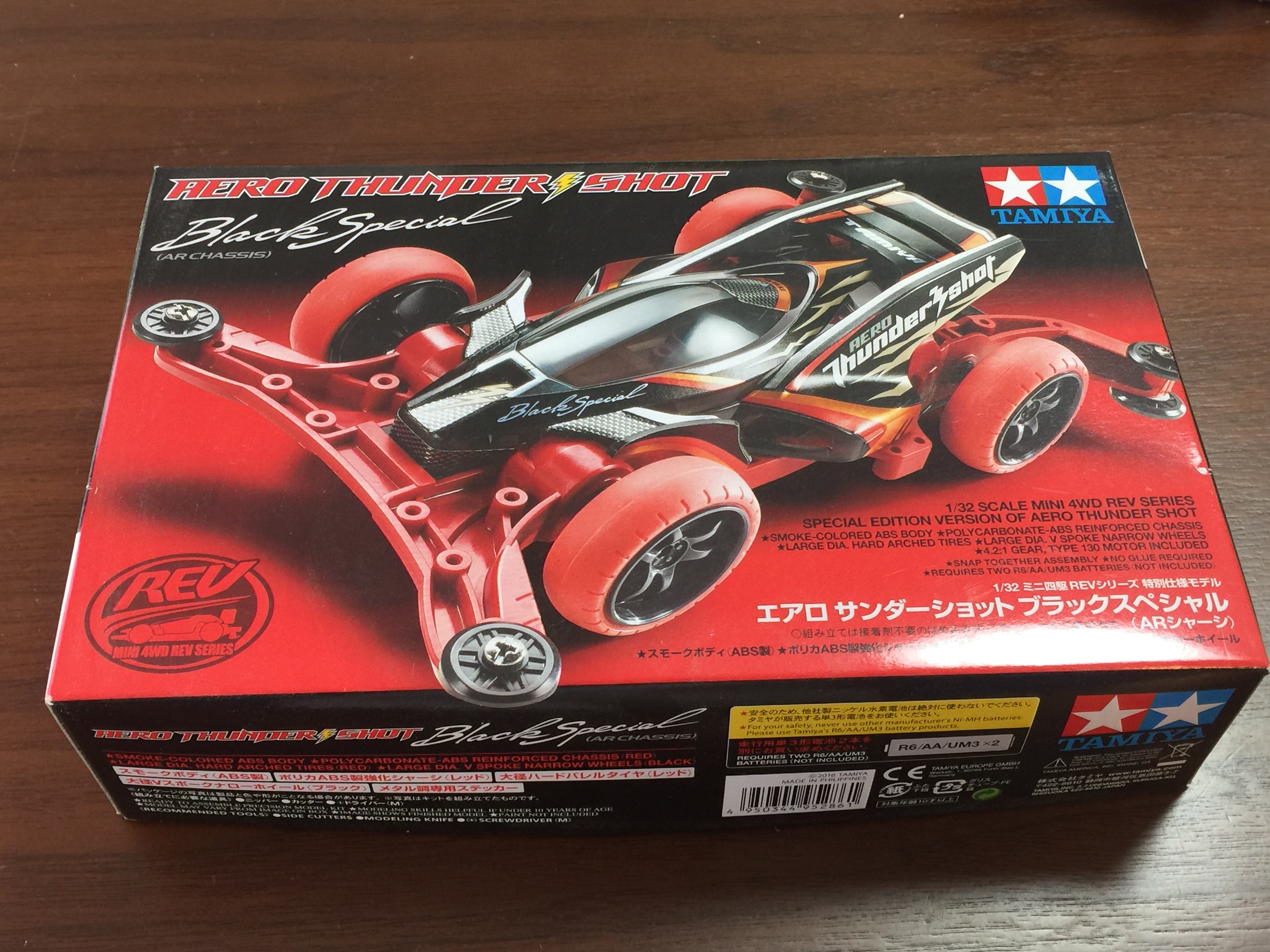
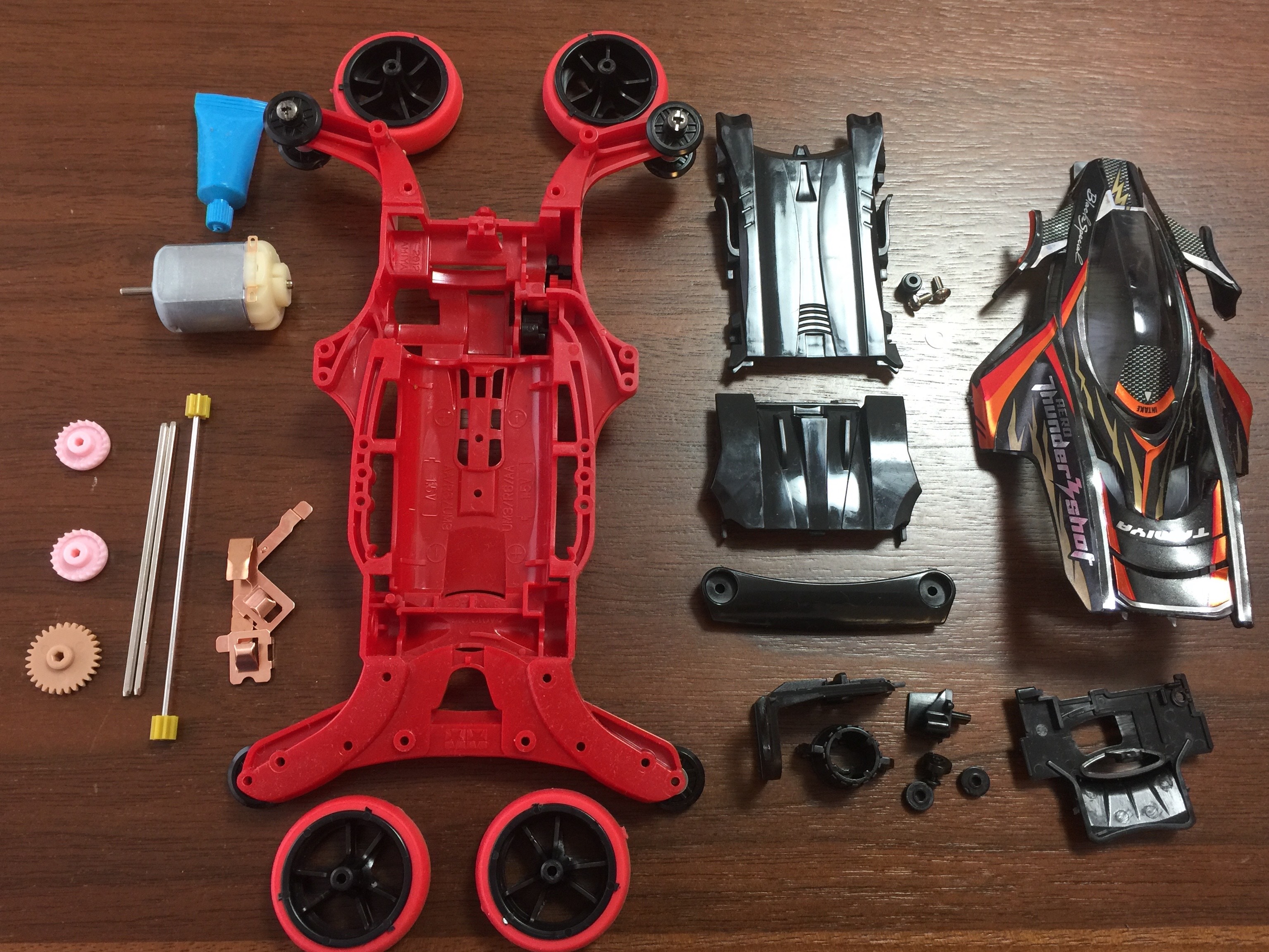
I loved to make a Mini 4WD which was sold by Tamiya Inc., one of the Japanese manufacturers of plastic model kits. This kit includes some parts of plastic model racing cars, a motor and grease. I enjoyed assembling while imaging the accomplished figure. After completion I played racing with boys. As they have lots of know how about motors, gears, and grease, we discussed how we could race our cars faster.

I also liked ZOIDS sold by Takara Tomy, a Japanese toy manufacturer. ZOIDS, as a coined word derived from English “ZOIC ANDROIDS”, are assembled toys as a motif of animals and dinosaurs with a gimmick such as walking and weapon operation using a motor. I enjoyed the process of creation and imagined the story those animals/dinosaurs fought and won the evil. Because there was a small person and operated the animal/dinosaur inside ZOIDS, I imagined as if I were inside and operated it.

These plays affect the way my think and learn as follows.

  • I assembled parts according to the instructions.
  • I considered why and how I can solve it when I got through difficulties.
  • I played in the imagination world.
  • I empathized with my friends.

Tech In Asia Tokyo 2018

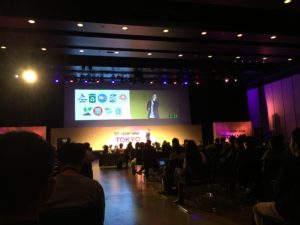
I enjoyed Tech In Asia Tokyo 2018 at Shibuya Hikarie yesterday. I heard Arena Pitch Battle. It was so excited.

There were eight pairs of startups as finalists who were selected from Asian countries. As a result of pitch judgment, Ginco, a crypto wallet app, won the championship. Stories about each products and services stuck in my heart.

Three judges, Kengo Ito, General Partner, D4V, Masaya Kubota, Partner, WiL and Ryu Hirota, Principal, Spiral Ventures asked keen questions to finalists and it became a very active place. They discussed feasibility, target, market, competitors, and the most obvious concept. I thought how important it was to communicate in a limited 5 minutes pitch and question-and-answer period.

It was the first time for me to join Tech In Asia. The venue atmosphere was cool and like a live house because of the dark tone and elaborate lightening. I felt it was different from another event hosted by Japanese domestic company. As many agendas were prepared, I would like to have fun next year.

Arena Pitch Battle Finalist
  • Ginco (Japan): The Next Generation Crypto Wallet
  • MaBeee (Japan): Communication dry cell battery developed by Novars Inc.
  • アメグミ(Japan): Smartphone OS Sunblaze specialized for busines
  • PEN Cube by PEN Robotics (Japan): A personal assistant robot equipped with face recognition camera and IoT remote control
  • GPU Eater by Pegara (Japan): Cloud services for deep learning
  • DubHub by Wika Media (Singapore): Provide the solution for viewers looking to enjoy a TV show or movie in a language they can understand.
  • mui by mui Lab (Japan): IoT device adjusts your environment
  • insureVite (Singapore): Chat bot for insurance service

Joichi Ito Lecture

I joined the lecture by Joichi Ito, a director of MIT Media Lab yesterday. It was meaningful enough to forget the passage of time. The most impressive story was what is going on in the world is connected the “loop”.

The ecosystem is the representative example of the loop. Solar energy raises plants, animals eat plants and plants turn oxigen into carbon dioxide emissions from animals.

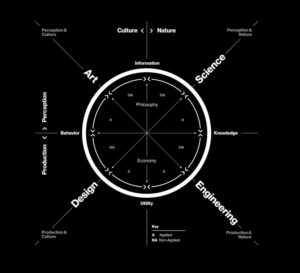
Krebs cycle of creativity shows academic loop, that multiples science, engineering, art and design to create something new.

Mr. Ito said the emergence of the Internet had a huge impact in the history of evolution of life. Some loops change more complicate system. For example, block chain, IT, security, terrorism, environmental issue…

One of the keys to adapt to the transformation of the world is changing the education system. The important thing is not to keep learning to replace artificial intelligence but to create your own passion and excitement by intertwining four elements such as science, engineering, art and design. I would like to find such “waku waku” excitement and to support you so that you can find it.

References

Spectrum. (2017). Neri Oxman’s Krebs Cycle of Creativity. Retrieved 2017, from https://spectrum.mit.edu/winter-2017/neri-oxmans-krebs-cycle-of-creativity/